Monday, May 13, 2013

Sunday, August 19, 2012
You Won't Get Much Fat from that Heart; And it Won't Pay the Bills, Either!
Okay, so I saw a comment on Facebook today that I must address: "So heart rendering what you have had to go through."
I know the writer meant heart-rending, and perhaps it was a simple typo; sometimes when we're typing fast our fingers type a word the way they want it typed when our mind is thinking something else. But perhaps this person actually thinks "rendering" was the correct word to use.
I offer a quick lesson on rending and rendering.
Render can mean several things. The root render means to give or hand over. As a transitive verb it can mean to submit or present (I rendered the bill to the customer.), to give (I rendered assistance to the stalled driver.), to give something owed (Let us render thanks to God.), to give in retribution (I rendered an apology for my rudeness.), to yield (I rendered the field to my opponent.), to represent, either in verbal form or in a drawing (I have tried to render my own feelings on the opera; My drawing did not render the subject well.), in computer science, to convert from a file into a visual form (I rendered the graphics file into a video display.), to perform or arrange in music (My own rendering of the musical piece was different from the composer's; I rendered the composition for a string ensemble.), to translate (I was able to render a translation that was accurate.), to pronounce (The jury rendered its verdict), to cause to become (Your news rendered me speechless!), and to reduce or melt down fat by heating (My grandfather used to render hog fat into lard.), and as a nautical term, to slacken (I rendered the rope for the captain of the ship.).
Rendering can be a noun, meaning the payment given for a good or service. There is also renderable, an adjective, and renderer, a noun.
None of those definitions would have been correct in the Facebook example I cite at the beginning of this post.
To rend something is to tear it or break it apart; it is to wrest, to divide, to pierce with sound, and to cause pain or distress.
Now heart-rending, on the other hand, is an adjective that means "causing or marked by grief or anguish". It is a synonym for heartbreaking and sorrowful. (And apparently it can be written as one word or as a hyphenated word.) I'm sure that is the expression the writer on Facebook was rendering to her friend.
But it was heartrending to me to see rendering used incorrectly.
I know the writer meant heart-rending, and perhaps it was a simple typo; sometimes when we're typing fast our fingers type a word the way they want it typed when our mind is thinking something else. But perhaps this person actually thinks "rendering" was the correct word to use.
I offer a quick lesson on rending and rendering.
Render can mean several things. The root render means to give or hand over. As a transitive verb it can mean to submit or present (I rendered the bill to the customer.), to give (I rendered assistance to the stalled driver.), to give something owed (Let us render thanks to God.), to give in retribution (I rendered an apology for my rudeness.), to yield (I rendered the field to my opponent.), to represent, either in verbal form or in a drawing (I have tried to render my own feelings on the opera; My drawing did not render the subject well.), in computer science, to convert from a file into a visual form (I rendered the graphics file into a video display.), to perform or arrange in music (My own rendering of the musical piece was different from the composer's; I rendered the composition for a string ensemble.), to translate (I was able to render a translation that was accurate.), to pronounce (The jury rendered its verdict), to cause to become (Your news rendered me speechless!), and to reduce or melt down fat by heating (My grandfather used to render hog fat into lard.), and as a nautical term, to slacken (I rendered the rope for the captain of the ship.).
Rendering can be a noun, meaning the payment given for a good or service. There is also renderable, an adjective, and renderer, a noun.
None of those definitions would have been correct in the Facebook example I cite at the beginning of this post.
To rend something is to tear it or break it apart; it is to wrest, to divide, to pierce with sound, and to cause pain or distress.
Now heart-rending, on the other hand, is an adjective that means "causing or marked by grief or anguish". It is a synonym for heartbreaking and sorrowful. (And apparently it can be written as one word or as a hyphenated word.) I'm sure that is the expression the writer on Facebook was rendering to her friend.
But it was heartrending to me to see rendering used incorrectly.
Thursday, July 14, 2011
Tuesday, May 31, 2011
Spell checkers
I don't use a spellchecker. I've been drilled in spelling and grammar, and it's not a bad thing. I was taught three foreign languages (one of them I'm typing in right now), and you can't properly learn a language if you don't know the basics. Spelling is so fundamental, in my mind, that (typing errosr aside) you shouldn't need a spellchecker. Pedantic? Me?? OK, use a spellchecker if you're not certain. And to weed out those typos. But for crying out loud, please use a passive one. I'm allergic to active spellcheckers, that change words for you, without you having to allow it or not. I came across this horrendous example in an article on the STV website - STV is the Scottish commercial television channel - about Scots cyclists who were in the Joplin tornado. Describing the scene, the article quotes:
The storm sirens whaled out. We had to sprint and get ourselves to the van and head to the storm shelter. It was terrifying; the sirens filled me with fear.
Well, I should not joke about such a devastating event as the Joplin tornado, where over 100 people died. But I am pouring scorn over the text editor on STV.tv, who did not spot that particular banana-skin. He will end up wailing about whales until the end of his days...
The storm sirens whaled out. We had to sprint and get ourselves to the van and head to the storm shelter. It was terrifying; the sirens filled me with fear.
Well, I should not joke about such a devastating event as the Joplin tornado, where over 100 people died. But I am pouring scorn over the text editor on STV.tv, who did not spot that particular banana-skin. He will end up wailing about whales until the end of his days...
Wednesday, March 16, 2011
Diffuse or defuse
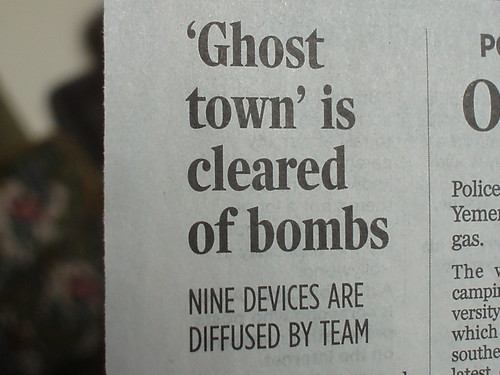
That is a headline from a regional paper in the north of Scotland last Monday. So we diffuse bombs - but do we defuse light? Looks like someone didn't check his spellchecker!
Friday, August 13, 2010
Can you read any more?

Or can't you read anymore?
This is a word that was formerly acceptable only as its split form, any more; however, it is now generally acceptable to use the combined form. It joins other such combinations as anyone, anything, anytime, anyway, and anywhere. However, there is an important distinction in which the separate form should be used. If referring to matters of quantity, the phrase should be two words. If one is full after a meal, the proper term would be, "I can't eat any more." If one is physically unable to eat, the phrase would be, "I can't eat anymore." The former refers to quantity, with the word "food" implied after "more," and "more" used as an adjective. In the latter, "anymore" is an adverb modifying the verb "eat."
Just to add a little confusion, anymore can have a regional meaning, specifically in the Midwest. I used it in speaking the other day and thoroughly confused the person I was speaking with. I can't remember the exact topic of the conversation, but a good example would be, "In Indiana, if you want to buy alcohol, it doesn't matter how old you look. You have to show your license anymore." In this case, it means "at the present time" or "nowadays." When I used it with my friend, they were very perplexed by what seemed to be a contradictory statement. They thought it would have made sense to have a negative in there: "You can't buy alcohol anymore unless you show your license." In that case, it would be using anymore as an adverb modifying buy. My usage was intended to show a time frame.
One of my sources says that such a usage "puzzles readers from other regions." I can testify to the truth of that! Other references state that it is not proper form in writing. As I thought about it, I don't believe it's anything that I use in writing. If I utilize that form, it is generally when speaking, which is when most colloquialisms and regional idioms are prone to "popping out."
Does anyone else here use anymore in that way? I know I'm not the only one. Here is a bevy of bathing beauties to prove it.
I rest my case.
Thursday, August 12, 2010
Plurals
Today is Glorious Twelfth, which sees the opening of the grouse shooting season here in the United Kingdom. So, if someone has a good aim, what do you say? How many grouse did you bag? Well, there are a few different plurals for nouns ending in -ouse.
House - houses
Blouse - blouses
Mouse - mice
Louse - lice
Grouse - grouse
It is one of my fave jokes to ask "how many hice in this street are afflicted with mice... "
House - houses
Blouse - blouses
Mouse - mice
Louse - lice
Grouse - grouse
It is one of my fave jokes to ask "how many hice in this street are afflicted with mice... "
Subscribe to:
Posts (Atom)